
AI-Native Businesses: How Small Teams Can Build Enterprise-Level Capabilities
For most of modern business history, capability followed size. Larger companies had the advantage of bigger teams, deeper departments, stronger technology, better reporting, more structured processes, and greater execution capacity. Smaller businesses could be faster and more personal, but they often lacked the internal machinery required to compete at the same level in research, sales intelligence, marketing consistency, customer support, financial analysis, workflow automation, and management reporting.
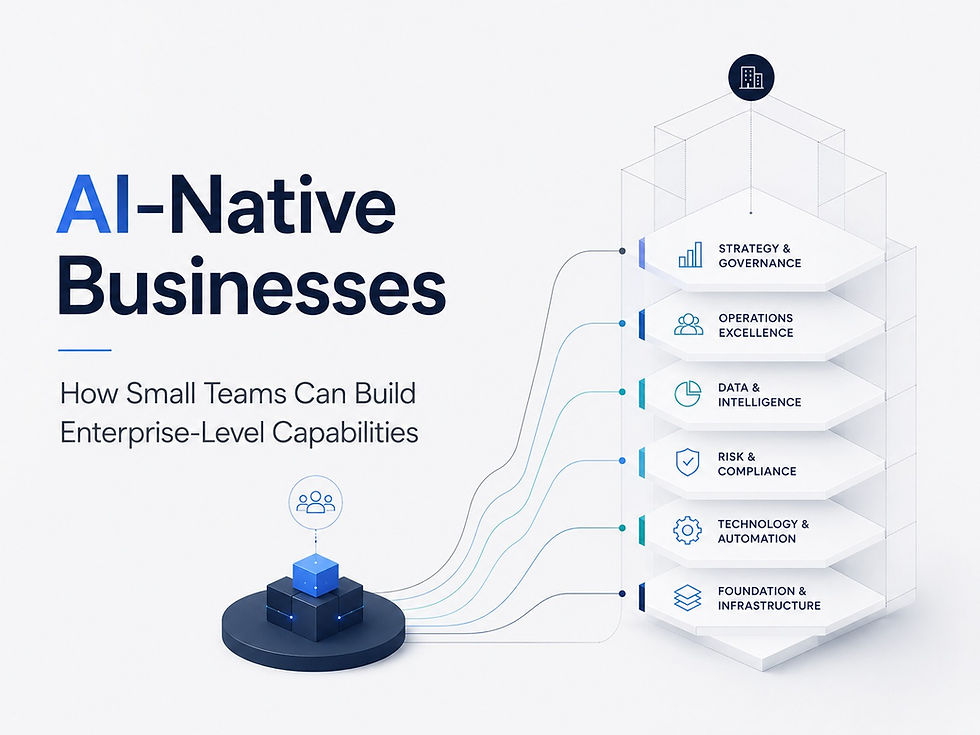
That relationship between size and capability is beginning to change. Artificial intelligence, automation, cloud software, data platforms, low-code tools, and intelligent workflows are allowing smaller teams to build capabilities that once required large departments. A company with ten people can now research markets, prepare account briefs, analyse customer conversations, build campaigns, generate management reports, automate repetitive tasks, and create internal tools with a level of speed and structure that would have been unrealistic only a few years ago.
This is the real meaning of an AI-native business. It is not a company that casually uses ChatGPT, buys a few AI subscriptions, or automates random tasks. It is a company that redesigns how work is done because artificial intelligence now exists. The most important opportunity for small and mid-sized businesses is not to look more technological. It is to become more capable than their size suggests.
The New Business Size Equation
From Headcount Advantage to Capability Advantage
For decades, business leaders often treated headcount as a proxy for strength. A larger sales team meant more market coverage. A larger marketing team meant more content, campaigns, and brand activity. A larger finance team meant better reporting. A larger technology team meant stronger systems. A larger operations team meant more capacity to deliver.
This logic still matters, but it is no longer complete. The next competitive gap will not simply be between large companies and small companies. It will be between capability-rich companies and capability-poor companies. Some businesses will have large teams but weak workflows, fragmented data, slow decisions, and poor execution discipline. Others will have small teams but strong systems, intelligent tools, reusable knowledge, and faster cycles of action.
AI changes the economics of capability because it allows work to be amplified. A person who could previously analyse ten customer conversations may now summarise and compare hundreds. A salesperson who spent hours preparing for a meeting can now generate an account brief in minutes and use the remaining time to improve judgment and strategy. A founder who relied on instinct can now review pipeline quality, margin movement, customer feedback, and market changes with better visibility.
The result is not that people become unnecessary. The result is that people become more leveraged. A small team that knows how to combine human judgment with intelligent systems can perform work that previously required many more people.
Why Tool Usage Is Not the Same as AI-Native Capability
Many businesses are already using AI, but usage alone does not create advantage. McKinsey’s 2025 State of AI survey found that 88 percent of organizations reported using AI in at least one business function, yet only 39 percent reported enterprise-level EBIT impact from AI. The same research highlights workflow redesign as one of the strongest contributors to meaningful business impact.This explains why the first wave of AI adoption has produced mixed results. Many companies have added AI tools to old ways of working. They use AI to write faster, summarise faster, search faster, or create faster, but the underlying business system remains unchanged. Leads are still poorly qualified. Sales notes are still scattered. Customer information is still incomplete. Proposals are still inconsistent. Reports are still delayed. Decisions are still made without enough visibility.
An AI-native business takes a different path. It does not ask, “Which AI tool should we use?” as the starting question. It asks, “Which business capability do we need to strengthen?” The difference is important. Tools create activity. Capability creates advantage.
The Small-Team Window
Small teams have a unique opening in this transition. Large companies have more resources, but they also carry more complexity. They have legacy systems, approval layers, internal politics, compliance burdens, and fragmented ownership across departments. This can slow down meaningful AI adoption, even when budgets are high.
Small and mid-sized businesses have fewer layers. They can choose a workflow, redesign it, test it, measure it, and improve it faster. They can turn founder knowledge into internal systems, customer conversations into market intelligence, and simple processes into repeatable workflows without waiting for large transformation programs.
The opportunity is not automatic. Many smaller businesses also struggle with weak data, limited technical skills, inconsistent processes, and owner dependency. But when a small team becomes disciplined about AI, it can convert agility into structured capability. That combination is powerful because it gives the business both speed and depth.
What Makes a Business Truly AI-Native
AI-Native Is an Operating Model, Not a Technology Label
A business becomes AI-native when artificial intelligence is embedded into how work flows through the company. It is not limited to one employee using prompts or one department experimenting with automation. It becomes part of how the company researches, decides, sells, supports, reports, learns, and improves.
This does not mean every process should be fully automated. In many areas, full automation is risky or unnecessary. Sales conversations, negotiation, customer relationships, strategic decisions, hiring, financial judgment, and sensitive customer issues still require human ownership. AI-native businesses are not machine-run businesses. They are human-led businesses with intelligent operating leverage.
The difference is visible in daily work. In a traditional small business, a sales enquiry may enter through email, WhatsApp, a website form, or a referral. Someone responds based on memory, searches manually for background information, prepares a proposal from an old file, and follows up if they remember. In an AI-native business, the same enquiry can trigger a structured workflow: company research, contact context, qualification notes, suggested response, relevant case examples, proposal sections, follow-up reminders, CRM updates, and management visibility.
The customer may never see the system behind the response. They simply experience a business that is faster, clearer, better prepared, and more professional.
The Core Shift Is From Individual Effort to Systemized Intelligence
Many growing businesses depend heavily on individual effort. A strong founder remembers customer history. A good salesperson knows which buyers matter. An experienced operations person knows how to solve recurring delivery issues. A finance person understands where the numbers are weak. This knowledge is valuable, but it is often trapped inside people.
AI-native businesses convert individual knowledge into systemized intelligence. They capture patterns, organise information, create templates, summarise conversations, build internal knowledge bases, and make useful context available at the moment of work. The goal is not to remove expertise. The goal is to make expertise more reusable.
This shift matters because small businesses often lose capability when one key person is unavailable, overloaded, or leaves the company. AI-native systems reduce that fragility. They help the company remember better, prepare faster, and perform more consistently.
The Best AI-Native Companies Redesign Work Before They Scale Tools
The greatest mistake in AI adoption is to automate work that was never properly designed. A weak sales process becomes a faster weak sales process. Poor customer data becomes faster confusion. Generic marketing becomes more frequent generic marketing. Unclear reporting becomes more polished but still misleading.
Deloitte’s Tech Trends 2026 makes a similar point about the move from pilots to AI-driven operations, noting that the shift is toward scaling intelligent operations rather than remaining in proof-of-concept mode. Deloitte also describes AI-native organizations as leaner, faster, and more strategic, with leaders moving toward human-agent teams and embedded governance.This is why the most serious question is not whether AI can perform a task. It is whether the business has designed the task properly. AI-native maturity begins with workflow clarity, not software selection.
The AI-Native Capability Ladder
Level One: Assist
The first level is assistance. At this stage, AI helps people complete individual tasks faster. It drafts emails, summarises documents, rewrites content, prepares meeting notes, translates messages, creates outlines, and answers basic research questions.
This is where most businesses begin, and it is a useful starting point. Assistance reduces small frictions in daily work. It helps employees move faster and improves output quality when used with good judgment.
However, assistance alone rarely creates durable advantage. If every competitor can use the same tools for similar tasks, the benefit becomes temporary. The business gains convenience, but not necessarily a stronger operating model.
Level Two: Accelerate
The second level is acceleration. AI is no longer used only for isolated tasks. It begins to speed up important workflows such as sales preparation, proposal creation, campaign planning, reporting, customer support, and internal documentation.
At this level, the business starts to see measurable improvements. Response times may fall. Proposal turnaround may improve. Marketing output may become more consistent. Management reports may become easier to prepare. Employees may spend less time on repetitive work and more time on higher-value judgment.
Acceleration is where AI begins to affect productivity, but it still requires discipline. Without clear workflows, acceleration can create noise. The company may produce more content, more reports, more messages, and more activity without improving business outcomes.
Level Three: Automate
The third level is automation. Repetitive and rules-based parts of workflows begin to run with less manual involvement. CRM updates, follow-up reminders, lead routing, meeting summaries, data cleaning, report generation, document classification, customer support drafts, and internal alerts can be automated within defined boundaries.
Automation is valuable because it reduces dependency on memory and manual discipline. Many business problems happen not because people are careless, but because the system depends too heavily on people remembering every small step. Automation helps protect consistency.
The risk is over-automation. A business should not automate work it does not understand. Before automation, the company should define the desired outcome, acceptable quality level, review point, exception process, and responsible owner. Responsible automation improves reliability. Blind automation creates faster mistakes.
Level Four: Advise
The fourth level is advisory intelligence. AI begins to support decisions, not just tasks. It helps leaders identify patterns in sales data, customer feedback, market signals, cost movement, campaign results, and operational performance.
At this stage, AI becomes a management companion. It may highlight which customer segments are converting better, which types of enquiries are wasting sales time, which products have stronger margin, which customer complaints are repeating, or which markets deserve more attention. The final decision remains human, but the quality of information improves.
This is one of the most important shifts for small businesses. Many SMEs do not have analysts, strategy teams, or dedicated business intelligence departments. AI can help create a lighter version of these capabilities when the underlying data is good enough.
Level Five: Adapt
The fifth level is adaptation. The business develops a learning system. It does not only use AI to complete work; it uses AI to improve how work is done. Customer questions improve the knowledge base. Sales objections improve messaging. Proposal outcomes improve templates. Campaign results improve targeting. Support issues improve operations. Financial patterns improve planning.
This is where AI-native businesses begin to compound. Each cycle of work improves the next cycle. The company becomes better not only because people gain experience, but because the system captures and reuses that experience.
Adaptation is the highest value stage because it creates cumulative advantage. The business becomes harder to compete with over time. It learns faster, responds faster, and improves more consistently than companies that treat every task as a fresh manual effort.
The Enterprise Capabilities Small Teams Can Build
Market Sensing Without a Large Research Department
Every business needs market intelligence, but few small companies have a formal research function. They often rely on founder instinct, customer conversations, competitor observation, and informal industry knowledge. These sources are useful, but they can be incomplete and inconsistent.
An AI-native business can build market sensing into its routine. It can monitor industry changes, competitor messaging, regulatory developments, customer pain points, investment announcements, hiring trends, technology shifts, and regional business signals. This information can be summarised weekly and translated into practical decisions about which markets to pursue, which offers to improve, and which customer problems to address.
This capability is especially valuable in the Gulf, where industries are changing quickly because of diversification, infrastructure investment, technology adoption, and government-led transformation. The World Bank’s 2025 GCC update highlighted rapid digital transformation across the region, 5G coverage exceeding 90 percent, high-speed internet, affordable connectivity, and significant investments in data centres and high-performance computing, with Saudi Arabia and the UAE emerging as AI readiness leaders.
For a small business, market sensing does not need to be complicated. It can begin with a defined list of industries, customers, competitors, and signals to review every week. The discipline is what matters. A business that sees market movement earlier has more time to adjust its positioning, outreach, offers, and investment decisions.
Revenue Intelligence Without a Large Sales Operations Team
Sales teams often lose time because they pursue poorly matched prospects, speak to the wrong roles, or enter conversations without enough context. The issue is not always effort. Many teams work hard, but their effort is spread across weak targets, unclear segments, and poorly timed opportunities.
AI-native businesses can create revenue intelligence without building a large sales operations department. They can use AI to segment target accounts, summarise company background, identify likely decision-makers, prepare industry-specific talking points, classify buyer fit, review past conversion patterns, and support better qualification.
This is not the same as sending automated sales messages. In fact, AI-native sales should make communication more relevant, not more mechanical. The value comes from preparing better before contact, understanding the buyer’s situation, and helping the sales team focus on opportunities with stronger commercial potential.
Data quality is central to this capability. AI can support sales intelligence only when the business has accurate company information, relevant contact data, clear segmentation, and disciplined CRM usage. Poor data creates poor targeting. Poor targeting creates poor conversations. Poor conversations create weak revenue outcomes.
Marketing Consistency Without a Large Content Team
Many smaller businesses market themselves inconsistently. They publish when time is available, send campaigns when sales are slow, and become silent when delivery becomes busy. This creates a visibility problem. The business may have strong expertise, but the market does not hear from it often enough to remember or understand its value.
AI-native marketing helps small teams build consistency. It can support article planning, campaign drafting, social media repurposing, customer education, case study development, SEO research, newsletter creation, and performance analysis. The business still needs human direction and brand judgment, but the production burden becomes lighter.
The strongest marketing benefit is not volume. It is continuity. A company can maintain a steady presence in its market, explain its expertise clearly, educate buyers, and turn internal knowledge into public authority. Over time, this creates a stronger growth asset than occasional promotional activity.
A good AI-native marketing system should also protect quality. It should avoid generic content, exaggerated claims, repetitive messaging, and careless automation. The goal is to make expertise more visible, not to flood the market with low-value material.
Customer Memory Without a Large Support Organization
Customer experience often depends on memory. What was promised? What problem happened last time? Which product did the customer buy? What did they complain about? Which person handled the issue? What follow-up was required?
Large companies often use ticketing systems, knowledge bases, service dashboards, and support teams to manage this information. Smaller businesses may rely on WhatsApp history, email threads, individual memory, or informal updates. This works for a while, but it becomes fragile as the business grows.
An AI-native business can build customer memory. It can summarise support conversations, organise FAQs, identify recurring issues, prepare response drafts, track commitments, and create internal knowledge from repeated customer questions. This improves consistency without removing the human side of support.
The best support model is not cold automation. Customers still need empathy, responsibility, and clear resolution. AI helps the team become better informed, faster, and more consistent. It reduces the chance that the customer has to repeat the same issue to multiple people.
Management Intelligence Without a Strategy Department
Small businesses often make decisions with limited visibility. Leaders may know monthly revenue but not true profit quality. They may know the number of enquiries but not the quality of conversion. They may know which customers are active but not which customers consume the most capacity. They may know the team is busy but not whether the work is creating value.
AI-native management reporting can change this. It can turn sales updates, customer data, financial numbers, operational notes, and campaign results into clearer management insight. It can help leaders ask better questions: Which customer segments are profitable? Which channels produce low-quality leads? Which sales stages slow down? Which offers create delivery pressure? Which costs are rising without enough return?
This capability matters because growth can mislead. More revenue does not always mean a stronger business. A company may grow sales while weakening margins, overloading people, delaying collections, or accepting poor-fit work. Management intelligence helps leaders separate activity from progress.
The value of AI is not that it makes decisions for the founder. The value is that it gives the founder a better view before making decisions.
Workflow Creation Without Heavy IT Dependence
One of the biggest limitations for smaller businesses has always been software creation. They may know exactly what workflow they need, but building it traditionally requires developers, agencies, budgets, and time. As a result, many businesses keep using spreadsheets and manual workarounds long after they become inefficient.
AI-native development platforms and low-code tools are reducing this barrier. Gartner identifies AI-native development platforms as a 2026 strategic technology trend and notes that organizations can have tiny teams paired with AI to create more applications with the same level of developers they already have. Gartner also predicts that by 2030 these platforms will help many organizations evolve large software engineering teams into smaller, more nimble AI-augmented teams.
For small businesses, the implication is practical. They can build internal forms, dashboards, automations, customer portals, reporting workflows, and simple operational tools faster than before. The objective is not to create software for its own sake. The objective is to remove friction from important work.
A Practical Example: The Twelve-Person B2B Services Company
The Traditional Version
Consider a twelve-person B2B services company selling to medium and large organizations. It has a founder, a small sales team, two marketing people, a few delivery staff, and basic administrative support. The company has good expertise, but its operations are informal.
Leads arrive from referrals, LinkedIn, website forms, email campaigns, and inbound calls. Some are answered quickly, others slowly. Salespeople research prospects manually when they have time. Proposals are adapted from old documents. Follow-ups depend on personal discipline. Marketing content is created irregularly. Customer objections are discussed in meetings but rarely documented. Management reports are basic and delayed.
This company may be working hard, but its capability is limited by manual coordination. It does not lack ambition. It lacks operating leverage.
The AI-Native Version
Now imagine the same company redesigned around AI-native workflows. Every qualified lead is entered into a CRM and enriched with company background, industry context, decision-maker information, and likely buyer priorities. Before the first call, the salesperson receives a short account brief with relevant questions and possible pain points.
After the call, AI summarises the conversation, extracts next steps, identifies objections, and updates the opportunity record. Proposal creation is supported by reusable sections, relevant case examples, and customer-specific language. Follow-up reminders are automated. Marketing reviews repeated sales questions and turns them into articles, emails, FAQs, and LinkedIn posts. The founder receives a weekly dashboard showing pipeline quality, proposal ageing, lost-deal reasons, customer segment performance, and expected cash impact.
The company still has twelve people. It has not become a large enterprise. But its operating capability has changed. It now has better sales preparation, stronger customer memory, more consistent marketing, clearer reporting, and faster internal learning.
The Real Advantage
The advantage is not that AI wrote a few emails. The advantage is that the company redesigned the relationship between information and action. Customer information no longer disappears after a conversation. Sales learning no longer stays inside one person’s head. Marketing is no longer separated from real buyer questions. Management no longer waits until the end of the month to see what is happening.
This is what enterprise-level capability means for a small team. It is not about looking large. It is about operating with a level of intelligence, consistency, and visibility that customers usually expect from larger companies.
Why AI-Native Capability Matters for Revenue Growth
Better Targeting Improves Sales Efficiency
Revenue growth is not only a function of more sales activity. It is a function of better sales efficiency. A business improves sales efficiency when it reaches more relevant buyers, qualifies opportunities earlier, prepares more effectively, shortens delays, improves conversion, and reduces wasted effort.
AI supports this when it is connected to good data and clear sales logic. It can help the team identify which accounts resemble existing high-value customers, which industries show stronger demand, which roles influence decisions, and which messages connect to real buyer problems. This allows the company to spend less time chasing weak opportunities and more time developing strong ones.
For small teams, this is critical because capacity is limited. A ten-person business cannot afford to pursue every enquiry, every sector, and every potential customer with equal energy. AI-native revenue intelligence helps the company become more selective without becoming slower.
Better Preparation Improves Buyer Confidence
Buyers notice preparation. A company that understands the buyer’s industry, business model, likely constraints, and decision context creates more confidence than one that begins with generic selling. Preparation signals seriousness.
AI can help sales teams prepare with greater consistency. It can summarise the target company, identify relevant news, compare competitors, suggest questions, review previous interactions, and highlight possible use cases. The salesperson still needs judgment, listening skill, and commercial maturity, but the starting point is stronger.
This matters in B2B because many deals are lost before the proposal stage. They are lost when the buyer feels the seller does not understand the business, cannot speak to the right problem, or is simply offering a generic service. AI-native preparation helps small teams appear sharper and more relevant without requiring hours of manual research for every meeting.
Better Learning Improves Conversion Over Time
Many sales teams repeat mistakes because they do not systematically learn from lost deals, weak meetings, objections, stalled proposals, and customer feedback. Learning happens informally, but it is not captured well enough to improve the next cycle.
AI-native businesses can analyse lost-deal notes, call summaries, customer replies, proposal feedback, and objection patterns. They can identify repeated reasons for delay or rejection. They can improve qualification criteria, update proposal language, adjust pricing communication, and create better proof points.
This turns sales from a series of individual efforts into a learning system. The business does not only sell. It studies how selling works in its market and improves continuously.
Why AI-Native Capability Matters for Profit
Productivity Gains Must Become Economic Gains
AI productivity is valuable only when it improves the economics of the business. If employees save time but the saved time is not redirected toward higher-value work, the company may see little financial benefit. If AI increases output but quality declines, the business may damage trust. If tools are added without removing old work, technology becomes another cost layer.
This is why AI-native businesses must connect productivity to economic outcomes. The question is not only, “Did AI save time?” The better questions are: Did it improve conversion? Did it reduce cost per sale? Did it improve proposal turnaround? Did it reduce customer support workload? Did it improve margin visibility? Did it allow the same team to handle more high-quality work without burnout?
Stanford’s 2025 AI Index notes that AI business usage is accelerating, with 78 percent of organizations reporting AI use in 2024, up from 55 percent the year before, and that a growing body of research shows AI can boost productivity and often narrow skill gaps. The next leadership challenge is to convert those productivity gains into measurable business value.
Margin Improves When Manual Load Falls
Profit improvement does not always require higher prices or more customers. It can also come from reducing manual load. When teams spend less time searching for information, preparing repetitive documents, formatting reports, rewriting similar emails, or manually updating systems, more time becomes available for work that creates value.
AI-native businesses can protect margins by removing low-value effort from daily operations. Salespeople can focus more on buyer conversations. Marketing teams can focus more on strategy and insight. Customer support teams can focus more on resolution. Founders can focus more on decisions. Finance teams can focus more on interpretation rather than compilation.
This is not about making people work faster until they are exhausted. It is about removing unnecessary friction so the same team can produce better outcomes with less waste.
Profit Quality Improves When Leaders See the Business More Clearly
Many businesses know their revenue but do not fully understand their profit quality. They may not know which customer types are expensive to serve, which offers create delivery strain, which discounts damage margin, or which sales channels produce poor-fit customers.
AI-native reporting can help leaders see these patterns earlier. It can organise data by customer type, project type, product line, region, sales channel, and delivery cost. It can highlight where revenue looks attractive but profit is weak.
This is crucial because growth can create hidden pressure. A business may feel successful while it is becoming less profitable, less focused, and harder to manage. AI-native management intelligence helps leadership grow with more discipline.
The Gulf Opportunity for AI-Native SMEs
The Region Is Building the Digital Foundation
The Gulf is becoming one of the world’s most important regions for digital transformation and AI investment. Strong connectivity, public-sector digital initiatives, cloud adoption, smart infrastructure, startup ecosystems, and national AI strategies are creating an environment where technology-led capability will matter across sectors.
PwC has estimated that AI could contribute US$320 billion to the Middle East by 2030, with Saudi Arabia expected to see the largest absolute gains and the UAE expected to see the largest relative impact at close to 14 percent of 2030 GDP. While forecasts should always be treated as estimates, the direction is clear: AI is becoming part of the region’s growth agenda.
This matters for businesses selling in or across the Gulf. Customers will increasingly expect faster service, better information, stronger digital experiences, clearer communication, and more professional execution. Companies that remain manual, slow, and fragmented may find it harder to compete.
SMEs Can Use AI to Meet Enterprise Expectations
Many Gulf SMEs sell to larger companies, government-linked entities, developers, contractors, distributors, healthcare groups, financial institutions, hospitality operators, and professional firms. These buyers often expect serious documentation, clear proposals, consistent follow-up, reliable communication, and strong delivery confidence.
AI-native capability helps SMEs meet these expectations. A small company can prepare better account research, create more professional proposals, maintain better follow-up, build stronger marketing assets, organise customer knowledge, and produce clearer management reporting. These are the behaviours that make a business feel more reliable to larger buyers.
The point is not that AI guarantees enterprise clients. It does not. But AI can help smaller companies close the professionalism gap that often separates them from larger competitors.
The Advantage Will Differ by Industry
AI-native capability will not look the same in every industry. A construction services company may use it for tender research, vendor communication, project documentation, and safety reporting. A logistics business may use it for customer support, route issue analysis, quotation workflows, and shipment updates. A healthcare company may use it for patient communication, scheduling intelligence, compliance documentation, and service quality analysis.
A professional services firm may use AI for research, proposals, client reporting, knowledge management, and thought leadership. A real estate firm may use it for buyer segmentation, listing intelligence, market updates, investor communication, and lead qualification. A manufacturing business may use it for supplier analysis, maintenance documentation, sales forecasting, and operational reporting.
The common principle is not the tool. The common principle is capability design. Each business must identify the workflows where intelligence, speed, consistency, and learning create the highest value.
The Risks of Becoming AI-Native
The Automation of Mediocrity
The first risk is automating weak work. If a business has poor positioning, weak data, unclear processes, or generic communication, AI can multiply those weaknesses. It may produce more content that does not matter, more outreach that does not convert, more reports that do not guide decisions, and more automation that creates confusion.
This is why AI-native transformation must begin with business thinking. Leaders should define what good looks like before they automate. What is a qualified lead? What makes a strong proposal? What information should be captured after a sales call? What does a useful customer update include? What metrics actually matter?
AI is powerful, but it is not a substitute for clarity. Without clarity, it scales confusion.
Data Weakness
The second risk is poor data. AI systems depend on the information they receive. If customer records are incomplete, sales stages are inaccurate, contact information is outdated, product details are inconsistent, and internal knowledge is scattered, AI outputs will be limited.
Data does not need to be perfect before a business starts. Waiting for perfect data can delay progress unnecessarily. But the company must treat data quality as a serious operating priority. Clean records, consistent fields, updated contact details, clear customer segments, and reliable activity notes create the foundation for better AI use.
For B2B companies, this is especially important because growth depends heavily on knowing which companies to target, which roles influence decisions, which industries are active, and which customer profiles create the best revenue quality.
Governance and Security Gaps
The third risk is careless usage. Employees may paste confidential information into tools, rely on inaccurate outputs, use unapproved platforms, expose customer data, or create content that has not been reviewed properly. As AI becomes more embedded in business workflows, governance becomes essential.
Gartner’s 2026 trends include AI security platforms, highlighting the need to secure third-party and custom AI applications, enforce usage policies, and protect against risks such as prompt injection, data leakage, and rogue agent actions. Gartner also predicts that more than 50 percent of enterprises will use AI security platforms by 2028.
Small businesses do not need heavy bureaucracy, but they do need practical rules. Teams should know what information can be entered into AI tools, which outputs require review, who owns each workflow, and how errors should be corrected. The governance model should be simple enough to use and strong enough to prevent avoidable damage.
Skill Gaps and Overconfidence
The fourth risk is assuming that AI makes expertise less important. In reality, AI increases the value of expertise because expert users can judge output quality. They know when an answer is incomplete, when a proposal sounds generic, when a financial interpretation is weak, or when a customer response misses the real issue.
A business that wants to become AI-native must train people to use AI with judgment. Employees need to learn how to give context, ask sharper questions, check accuracy, protect sensitive information, and improve outputs. The skill is not only prompting. It is thinking clearly with better tools.
Overconfidence is dangerous. AI can produce fluent answers that sound correct but require verification. A mature AI-native business keeps humans responsible for important decisions.
How to Build an AI-Native Business in 90 Days
Days 1–15: Choose the Capability, Not the Tool
The first step is to select one business capability that matters. The company should avoid starting with a broad ambition such as “we need to use AI everywhere.” A better starting point is specific: improve lead response, reduce proposal time, strengthen customer support, create weekly management reporting, organise customer knowledge, or improve sales preparation.
The leadership team should define the current problem clearly. Where does work slow down? Where does information get lost? Where does quality depend too much on one person? Where are customers waiting? Where are employees repeating the same manual task?
This diagnostic stage does not need to be long, but it must be honest. The chosen capability should connect to a real business outcome such as faster response, better conversion, improved margin visibility, reduced manual work, or stronger customer experience.
Days 16–30: Map the Workflow
The second step is workflow mapping. The business should document how the selected work currently happens from start to finish. For example, if the chosen workflow is proposal creation, the team should map how the enquiry enters, who qualifies it, what information is collected, how the customer need is understood, where old proposal material is stored, who prepares pricing, who reviews the proposal, how it is sent, and how follow-up happens.
This exercise usually reveals the real problem. The issue may not be writing speed. It may be missing customer information, unclear qualification, old templates, poor pricing logic, delayed review, or weak follow-up ownership.
Once the workflow is visible, the company can identify where AI should assist, accelerate, automate, or advise. This is far more effective than simply giving employees a tool and hoping productivity improves.
Days 31–50: Build the Knowledge Base
The third step is to organise the material AI and employees will use. This may include product descriptions, service explanations, FAQs, pricing logic, case examples, proposal templates, customer objections, sales scripts, company profiles, industry notes, delivery steps, and internal policies.
The knowledge base does not need to be complex. It can begin as a structured folder, shared document, CRM library, or internal wiki. The important point is that the company creates a reliable source of truth.
This step is often where small businesses create immediate value. When scattered knowledge becomes reusable, the team becomes more consistent even before advanced automation begins.
Days 51–70: Pilot the AI-Native Workflow
The fourth step is to test the redesigned workflow with a small group. The company should not roll out everything at once. A focused pilot allows the team to identify errors, improve prompts, refine templates, update data fields, and clarify human review points.
For a sales preparation workflow, the pilot might produce account briefs for every qualified meeting. For a proposal workflow, it might generate first drafts using approved templates and customer-specific inputs. For a customer support workflow, it might summarise issues, suggest replies, and update a knowledge base. For management reporting, it might prepare a weekly summary of pipeline movement, lost-deal reasons, and customer segment performance.
The pilot should be measured against a business outcome. Did preparation improve? Did response time fall? Did proposal quality become more consistent? Did the team save time? Did managers gain better visibility?
Days 71–90: Measure, Govern, and Scale
The final step is to measure results and decide whether to scale. The business should review what improved, what created risk, what employees found useful, what customers noticed, and what needs better control.
Governance should be added before expansion. This includes data rules, output review standards, tool ownership, approved templates, escalation points, and measurement dashboards. Governance should not slow down the business unnecessarily. It should protect quality as usage expands.
Once the first workflow is working, the company can move to the next. AI-native capability is built through repeated workflow upgrades. Over time, these improvements connect and create a stronger operating system for the business.
What Leaders Must Understand
AI Is a Leadership Decision, Not Only a Technology Decision
AI-native transformation cannot be delegated entirely to IT, marketing, or the most enthusiastic employee. It affects how the business works, how teams make decisions, how customers are served, how information is governed, and how performance is measured.
This makes it a leadership issue. Leaders must decide where AI matters most, what risks are acceptable, which workflows should change, how employees should be trained, and how success will be measured.
The best leaders will not ask AI to replace business thinking. They will use AI to improve business thinking. They will bring sharper questions, clearer priorities, stronger judgment, and better accountability to the technology.
The Human Role Becomes More Important
As AI becomes more capable, the human role shifts upward. People spend less time on repetitive preparation and more time on judgment, relationship-building, interpretation, creativity, negotiation, problem-solving, and decision-making.
This shift requires a different kind of employee development. Businesses need people who can work with intelligent systems, but also challenge them. They need employees who can understand context, evaluate quality, protect customer trust, and turn AI-generated output into useful business action.
The future is not simply human versus machine. In strong businesses, the future is human judgment multiplied by machine intelligence.
The Best Small Businesses Will Not Stay Small in Capability
Some of the most competitive businesses of the next decade may appear modest from the outside. They may not have huge teams or large offices. But inside, they will have strong data, reusable knowledge, AI-supported workflows, automated handoffs, management dashboards, customer memory, and faster learning cycles.
These companies will not compete by pretending to be large. They will compete by being unusually capable. They will respond faster, prepare better, communicate more clearly, learn from every interaction, and improve with less friction.
That is the real promise of AI-native business building.
Conclusion: The Future Belongs to Capability-Rich Businesses
AI is not just another productivity tool. Used well, it changes what a business can become. It allows small teams to build market intelligence, revenue intelligence, customer memory, management reporting, workflow automation, and software-enabled execution without waiting to become large enterprises.
But the advantage is not automatic. Businesses will not become stronger by adding random AI tools to weak processes. They will become stronger by redesigning work, improving data, training people, governing risk, measuring outcomes, and turning repeated effort into reusable intelligence.
The next generation of strong businesses may not be defined by headcount alone. They will be defined by capability density: how much intelligence, speed, consistency, learning, and execution power they can build into every person, process, and customer interaction.
For small and mid-sized businesses, this is a rare strategic opening. AI gives them the chance to compete not by becoming bigger first, but by becoming smarter first. The companies that understand this early will not simply use AI. They will build around it. And in the years ahead, that may be one of the clearest differences between businesses that stay busy and businesses that become genuinely stronger.


Comments