
The Great Convergence: How AI, Energy, Robotics, Biotechnology and Advanced Manufacturing Are Reshaping the Global Economy
An AI model that proposes a new material is impressive. A laboratory that can test promising candidates, a factory that can reproduce the successful result and an energy system that can support production are what turn that possibility into economic change. Each capability matters individually. The larger transformation begins when they work together—and when what happens in the physical world improves the next round of design.
This is a more useful way to understand technological change than treating every breakthrough as a separate revolution. Artificial intelligence, robotics, biotechnology, advanced manufacturing and energy are usually discussed through their own industries, investment categories and specialist communities. Yet the most consequential developments increasingly appear at their intersections: computational tools working with biological research, intelligent software coordinating physical machines, and manufacturing systems helping turn scientific discoveries into practical capabilities. The World Economic Forum’s 2026 research on technology convergence identifies this interaction between technological domains as an increasingly important source of competitive advantage.
The Great Convergence does not mean these fields are advancing at the same speed, that every promising technology will succeed or that all industries are becoming one. It describes something more specific: progress in one field can expand what becomes possible in another, while the combination creates capabilities that neither could deliver alone.
For businesses, the implications extend well beyond adopting the latest software. They concern what can be discovered, what can be manufactured, where industries can develop and which capabilities become valuable. Understanding this shift requires looking beyond individual technologies to the relationships between intelligence, experimentation, production and the infrastructure that makes them possible.
The Breakthrough Is Also in the Connections
A collection of advanced technologies is not automatically a transformative system. A company can own sophisticated software, expensive equipment and extensive data while still struggling to move an idea from research into production. Convergence becomes economically meaningful when the output of one capability becomes a useful input for another—and when the connections are reliable enough to support repeated work.
Consider the difference between generating a design and improving a product. A design is a proposal. It becomes more valuable when engineers can test it against practical constraints, manufacture it consistently, observe its performance and use that evidence to make the next version better. The important development is therefore not simply greater computational power. It is the possibility of shortening and strengthening the entire journey from a question to a verified result.
Digital twins illustrate part of this connecting mechanism. These are digital representations linked to physical systems, allowing information from equipment and processes to inform monitoring, simulation and decisions. Their usefulness depends on the quality of the connection between the model and reality, rather than on how sophisticated the visualisation appears. NIST emphasises the importance of synchronised data, sensors, connectivity and predictive models in making these systems useful.
The distinction matters because it changes what businesses should look for. A striking demonstration may reveal a new capability, but a working connection between design, testing and operation can change how an organisation learns. The first shows that something is possible. The second can make that possibility repeatable.
The underlying idea is not that all progress has suddenly become interconnected; technologies have always depended on complementary capabilities. The opportunity is to make those connections more deliberate, more measurable and more responsive to evidence. That is where convergence moves from an interesting observation to an industrial and commercial strategy.
Five Foundations, Different Roles
Artificial intelligence contributes methods for recognising patterns, making predictions, exploring alternatives and supporting decisions. Its industrial significance extends beyond producing text or images. In scientific and technical settings, it can help researchers and engineers work through complex possibilities that would otherwise be difficult to investigate systematically. Stanford’s 2026 AI Index reflects this widening application through its coverage of AI across biology, chemistry, physics and other scientific disciplines.
Robotics provides a means of acting in the physical world. Moving an object, carrying out a laboratory procedure or inspecting a component requires more than a correct prediction. It requires equipment capable of performing the action, sensing what happened and responding appropriately. Robotics connects computational decisions with material consequences.
Biotechnology works with living systems and their components. It expands the possibilities for understanding biological processes, developing medicines and using biological capabilities in production. Its role in convergence is distinctive because biological systems are not simply another type of software or machinery; their behaviour must be understood and tested on their own terms.
Advanced manufacturing turns designs and discoveries into reproducible products. It includes more than additive manufacturing or highly automated factories. Precision processes, measurement, materials expertise, quality control and production engineering all determine whether a promising result can be made consistently, at an acceptable cost and in sufficient quantities.
Energy supplies the physical capacity behind the entire system. Computation, laboratories, machinery and production all depend on it. Energy technologies also benefit from improvements in modelling, materials and manufacturing, making energy both a foundation of convergence and a field transformed by it.
These five areas provide a useful organising framework, not an exhaustive map. Semiconductors, sensors, communications, materials science and human expertise connect them throughout. The important question is not whether every project includes all five, but whether combining relevant capabilities produces a better outcome than improving each one separately.

AI and Robotics: When Intelligence Enters the Physical World
The economic importance of robotics does not depend on machines looking human. A system that moves inventory efficiently, handles a repetitive production task or performs a precise inspection can create substantial value without resembling a person. The International Federation of Robotics recorded approximately 542,000 industrial robot installations worldwide in 2024, with annual installations exceeding half a million for the fourth consecutive year. This establishes a substantial industrial base on which further advances can build.
AI adds another dimension to that base. Instead of focusing only on the performance of an individual machine, it can help improve how groups of machines interact with their surroundings and with one another. Amazon’s DeepFleet provides a concrete example. In 2025, the company described models trained on robot movement data to predict traffic patterns, support task assignment and route mobile robots around potential congestion in its fulfilment operations.
The commercial insight is larger than warehouse navigation. A robot’s usefulness depends partly on the system around it: where materials arrive, how work is allocated, what happens when an exception occurs and whether one machine’s improvement creates a delay elsewhere. A faster robot does not necessarily produce a faster operation. Intelligence becomes more valuable when it improves coordination across the full process.
This creates the possibility of a productive feedback loop. Operating machines generate observations about their environment. Those observations can help improve models, planning and future deployment. But the loop only works when the data is relevant, the learning is validated and changes remain safe under real operating conditions. Simply accumulating more activity does not guarantee improvement.
For business leaders, the right question is therefore not whether a robot can perform an impressive action once. It is whether the complete operation can deliver acceptable quality, throughput and cost repeatedly, including during disruptions. A system that performs a narrow task dependably may be commercially more important than a more general machine that still requires frequent intervention. Convergence should be judged by the work it enables, not by the appearance of the equipment performing it.
The Self-Driving Laboratory: A New Way to Generate Knowledge
One of the most significant intersections is emerging inside the laboratory. A conventional research process already involves a cycle of proposing an experiment, conducting it, interpreting the result and deciding what to test next. A self-driving laboratory connects parts of that cycle through automated equipment and algorithmic decision-making, allowing results from one experiment to guide subsequent experiments.
RoboChem-Flex, described in Nature Synthesis in April 2026, demonstrates this approach in chemical reaction optimisation. The researchers combined modular hardware, automated control and optimisation software, validating the platform across six different case studies. Importantly, the system supported both fully closed-loop operation and configurations involving human participation. It was a demonstration of connected experimental capabilities, rather than a claim that scientific research no longer needs scientists.
The distinction between performing more experiments and choosing better experiments is crucial. Greater throughput can be useful, but an intelligent experimental system should also help decide which uncertainty is worth resolving next. The economic objective is not to maximise laboratory activity. It is to obtain more useful knowledge from the time, equipment and materials available.
An earlier battery study shows the potential. Research published in Nature in 2020 combined early predictions of battery lifetime with an optimisation method that selected promising charging protocols. The researchers identified high-cycle-life protocols from a space of 224 candidates in 16 days, compared with more than 500 days for the specified exhaustive-search approach without early prediction. This was a result for a defined experimental problem, not a universal acceleration factor for battery research.
The broader implication is nevertheless substantial. When experimentation is slow or expensive, improving the choice and sequence of experiments can change which problems are practical to investigate. Research teams may be able to explore alternatives that previously exceeded their resources, reject weak directions earlier and concentrate physical testing where it contributes the most information.
Human responsibility remains central to this model. Someone must define the objective, determine whether the measurements are meaningful and recognise when the system is optimising the wrong thing. Faster experimentation is valuable only when it produces trustworthy evidence. The laboratory becomes more powerful when computation and automation strengthen scientific judgement, rather than merely increasing the speed at which a flawed assumption is repeated.
Biotechnology: From Predicting Life to Producing With It
Biotechnology brings a different kind of complexity into convergence. Biological systems contain interactions that are difficult to infer from any single measurement or model. The opportunity is not to assume that life behaves like software, but to use computational methods to investigate biological possibilities more effectively while retaining experimental validation as the ultimate test.
AlphaFold 3 offers an important milestone. Published in Nature in 2024, the research extended structure prediction to complexes involving proteins, nucleic acids, small molecules and other molecular components. It demonstrated improved performance across several prediction tasks, expanding the kinds of biological interactions researchers could investigate computationally. The achievement was a more capable research tool—not a complete simulation of life or a replacement for biological experiments.
For medicine, this distinction has direct economic importance. A more useful prediction can help researchers form hypotheses and prioritise experiments, but it does not establish that a treatment will be safe or effective in people. The FDA’s explanation of clinical research makes the underlying point clearly: even preclinical evidence is not a substitute for studying how a drug interacts with the human body. Computational progress can improve parts of the discovery process without removing the subsequent burden of proof.
Biotechnology’s significance also extends beyond healthcare. Research at the University of Texas at Austin, published in 2022, used machine learning to help engineer an enzyme capable of breaking down selected PET plastics under experimental conditions. The work demonstrated the recovery of molecular building blocks and their use in making PET again. This linked computational methods, biological engineering and materials processing in a single research programme. It did not establish that every plastic could be treated the same way or that industrial-scale economics had already been solved.
The possibility is striking because it changes how a production problem might be approached. A material challenge does not always have to be solved through a more powerful machine or a different conventional chemical process. In some cases, a biological capability may become part of the solution. The practical value then depends on whether that capability can operate within the cost, reliability and environmental requirements of an industrial system.
Using biology to manufacture useful products is not new. The FDA approved biosynthetic human insulin in 1982, an important demonstration of how biological engineering could become a dependable medical production capability. That history is a useful corrective to claims that biomanufacturing is entirely a future industry. The emerging opportunity lies in extending and improving what can be designed and produced, rather than inventing the principle from nothing.
The difficult transition is from a successful result to a viable production process. Facilities, equipment, process development, quality assurance and commercial demand must come together. The US National Security Commission on Emerging Biotechnology has identified the ability to demonstrate scale-up as a major obstacle to commercialisation. Its analysis reinforces a central lesson of convergence: discovering something valuable and building the capacity to supply it are different achievements, and both are necessary.
Advanced Manufacturing: Closing the Distance Between Design and Reality
A digital design can be changed almost immediately. A physical product must satisfy the realities of materials, tolerances, assembly, operating conditions and quality control. Advanced manufacturing matters because it connects the freedom to explore designs with the discipline required to make them work outside a computer.
NASA’s work on AI-assisted mission hardware illustrates this relationship. In 2023, the agency described “evolved structures” generated from engineering requirements and physical constraints. Engineers specified interfaces and restricted areas, while the software explored structural designs. The resulting parts still required human review and established validation processes. The example showed how computational design could change the search for an engineering solution without eliminating engineering responsibility.
This is more consequential than simply producing unusual shapes. When a design process can explore a wider range of alternatives, manufacturing determines which of those alternatives can become useful products. A theoretically superior component may be too difficult to produce, inspect, repair or assemble. Conversely, a new production method may make a previously impractical design commercially attractive. Design capability and manufacturing capability therefore develop in relation to each other.
Digital twins can strengthen that relationship by connecting models with information from physical operations. NIST describes their potential to help manufacturers diagnose, predict and optimise processes, while also highlighting challenges around interoperability, verification and validation. The important capability is not a digital copy for its own sake. It is a model trustworthy enough to support a specific operational decision.
Consider the potential feedback from a production line to an engineering team. If a design repeatedly creates difficult assembly conditions, inconsistent quality or premature wear, those observations should influence subsequent decisions. A connected system can make production experience part of product development rather than leaving it as information held separately by another department.
This is where manufacturing becomes more than the final stage of innovation. It can become a source of knowledge about what designs actually work. The commercial advantage may come from reducing the distance between an idea and the evidence needed to improve it. That distance includes organisational handovers and incompatible information as much as it includes machinery.
Energy: What Powers the System—and What the System Can Improve
The digital economy does not operate separately from the physical economy. Its computation takes place in facilities supplied by electricity networks and supported by cooling and other infrastructure. As demand for computing expands, the availability and reliability of that infrastructure become part of the technology story.
In its April 2026 outlook, the International Energy Agency estimated that electricity consumption across all data centres—not AI alone—would rise from approximately 485 terawatt-hours in 2025 to around 950 terawatt-hours in 2030 under its central projection. The latter figure is a forecast, not an observed outcome. Its importance lies in showing how a digital capability can create substantial requirements for physical investment.
The relationship also runs in the opposite direction. Computational tools can improve the operation of energy-consuming systems. In 2016, DeepMind reported a 40% reduction in the energy used for cooling in its application to a Google data centre. The scope matters: this was cooling energy, not a 40% reduction in the facility’s total electricity consumption. Even with that distinction, it remains a concrete example of AI being used to improve part of the infrastructure on which computing depends.
This creates an important tension. Greater computational capability can help make energy use more efficient while also supporting new applications that increase total demand. There is no logical requirement for the savings in one area to outweigh growth elsewhere. Evaluating the relationship requires looking at the complete system, including how much additional activity becomes worthwhile when individual tasks become cheaper or more capable.
Grid infrastructure introduces another constraint. Better software can help operators make decisions, but it does not eliminate the need for adequate physical connections. The IEA’s Electricity 2026 analysis identifies insufficient grid capacity as a bottleneck affecting the connection of generation, storage and new demand. The ability to build or access a working electricity system can therefore influence where technologically advanced activities are able to expand.
Energy is also a manufacturing story. Batteries, solar equipment, power electronics and other technologies must move through industrial supply chains before they become operating assets. The IEA’s analysis of clean-technology manufacturing makes clear that production capacity, industrial competitiveness and supply-chain structure are integral to the development of energy systems. Scientific performance is only one part of that larger equation.
For businesses, the implication is to treat energy as a strategic dependency rather than a background utility. Its cost, quality, availability and infrastructure requirements belong in decisions about technology deployment. Equally, energy-related capabilities can themselves become areas of opportunity when better sensing, modelling, materials or production methods solve a measurable operational problem.
When Progress Begins to Reinforce Itself
The deeper promise of convergence appears when these relationships form a loop. Better models can improve the choice of experiments. Better experiments can generate more useful evidence. That evidence can inform improved materials or processes, which manufacturing systems can attempt to reproduce. Performance in production can then inform further research and design.
Consider a plausible development path for an energy-storage technology. Computational methods could help prioritise research directions; automated testing could investigate selected candidates; production engineering could improve consistency; and field performance could reveal where the next improvement is needed. If the resulting technology becomes more useful, it could support some of the physical systems involved in further innovation. This is a possible reinforcing relationship, not a claim that every battery development programme follows the same path.
The important economic concept is cumulative capability. A successful investment may create more than the immediate product or process improvement. It may also leave behind better data, validated methods, improved equipment and a team that can address the next problem more effectively. Those additional capabilities can make subsequent work easier—but only when the organisation deliberately preserves and applies what it learns.

This is why the quality of feedback matters so much. A system that records only success, loses the context of measurements or cannot connect operating results to earlier decisions will learn less than its activity suggests. Convergence is strongest when it improves the ability to discover what is wrong as well as what is promising.
There is no guarantee that such loops produce uninterrupted or exponential progress. Physical limits, costs and unresolved scientific questions still matter. The more useful proposition is that connected capabilities can improve the rate at which organisations turn uncertainty into dependable knowledge.
The Economic Shift: From Cheaper Tasks to Greater Productive Capacity
It is tempting to evaluate new technologies primarily through labour savings: how many hours a tool removes or how many tasks a machine completes. Those measures can be relevant, but they capture only part of convergence’s potential. The larger question is whether the combined system changes what an organisation can economically achieve.
One effect is a lower cost of exploring alternatives. When a business can evaluate more designs or research directions within the same resources, it may discover an option that would otherwise remain unexplored. That creates value through improved choices, not merely through faster execution of an existing choice. The relevant measure becomes the cost of reaching a useful, verified result.
Another effect is the possibility of using existing assets more productively. Better coordination, more consistent quality or fewer avoidable failures can increase the useful output of a facility without an equivalent increase in physical capacity. But those gains should be measured across the complete operation. Improving one activity while creating additional inspection, integration or rework elsewhere may simply relocate the cost.
A third effect is the expansion of what becomes commercially feasible. A product that was technically possible but prohibitively difficult to design, test or manufacture may become practical when several constraints improve together. This is where convergence can support new markets rather than merely reducing the cost of serving existing ones.
These outcomes require complementary investment. Research on the “Productivity J-curve,” published in the American Economic Journal: Macroeconomics, explains how general-purpose technologies depend on additional investments, including intangible capabilities that are not always well captured in conventional measurement. The implication for businesses is that purchasing technology and building the organisation capable of using it are distinct activities.
Training, process redesign, data preparation and integration can absorb resources before the full benefits appear. That does not justify indefinitely postponing accountability. It means evaluations should distinguish between the cost of establishing a capability and the economics of operating it once established. A serious convergence strategy must demonstrate both that the system works and that its benefits justify the complete investment required.
Abundance Moves the Bottlenecks
When one capability becomes easier to obtain, another often becomes more important. If a company can generate far more promising designs, it may discover that testing capacity is the constraint. If testing becomes faster, production qualification may become the constraint. Once production is dependable, distribution, customer acceptance or service capacity may determine whether the improvement reaches the market.
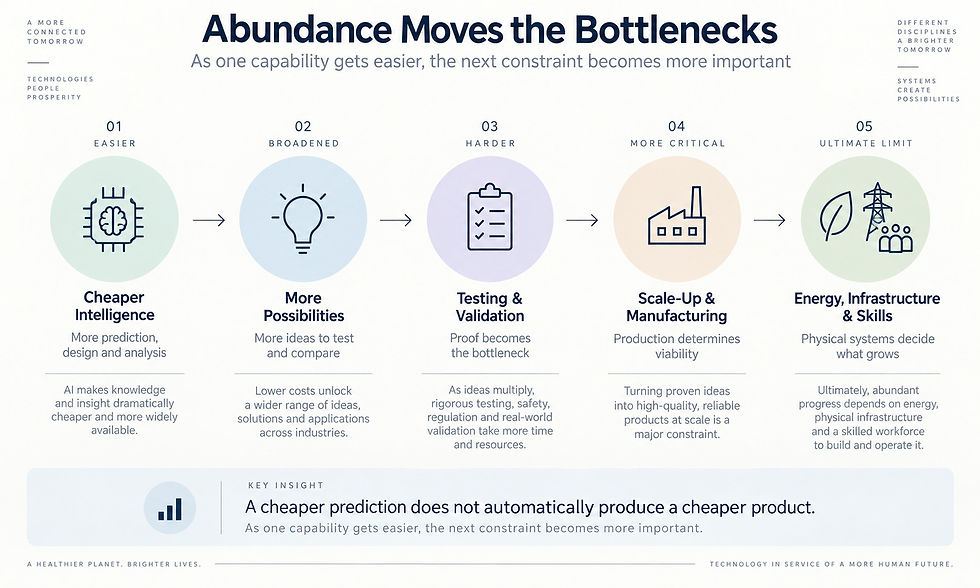
This suggests a useful principle: a cheaper prediction does not automatically produce a cheaper product. The value of the prediction depends on what happens next. Generating additional possibilities can even increase the burden on an organisation that lacks the ability to assess them. More ideas are not always the scarce resource; reliable ways to establish which ideas deserve action may be more valuable.
Biotechnology makes this particularly visible. Computational progress can expand the set of possibilities researchers investigate, while facilities and scale-up capabilities remain necessary to turn promising results into supply. The gap between discovery and commercial production is therefore not an inconvenience that advanced software simply removes. It is a separate area of work and investment.
Convergence also runs on different clocks. Software capabilities can change more quickly than large physical systems can be planned, built and integrated. Energy infrastructure illustrates the resulting coordination problem: demand can develop faster than the grid capacity needed to support it. Companies that plan around the fastest-moving part of the system may underestimate the significance of its slower dependencies.
For strategy, the task is to identify the constraint that actually limits the outcome. That may be a component, a testing process, access to infrastructure, a specialist skill or a difficult organisational handover. The answer will differ between industries and change as other constraints are resolved.
However, identifying a bottleneck is not the same as identifying a guaranteed source of profit. Scarcity can attract competing suppliers, encourage customers to redesign around it or justify new capacity that eventually changes the economics. The durable advantage belongs to a useful capability that continues to matter, not simply to a temporary shortage.
A Different Map of Industrial Advantage
Convergence changes how industrial locations should be evaluated. A single attractive input—cheap electricity, skilled researchers or available land—may be valuable, but its usefulness depends on the complementary capabilities around it. A research cluster needs ways to test and commercialise discoveries. A production facility needs suitable infrastructure, suppliers and expertise. Competitive locations are combinations, not isolated advantages.
The IEA’s 2026 analysis of clean-energy supply chains shows why the complete chain matters. It identifies concentrated production and vulnerable stages within those chains, demonstrating that the presence of final manufacturing capacity does not necessarily eliminate dependence elsewhere. Industrial capability must be assessed through its essential components and processes, rather than through the visibility of the finished product alone.
For governments and regions, this supports a practical interpretation of industrial development: strengthen the connections between research, infrastructure, production and skills. Shared testing facilities or well-designed technical training may sometimes help commercialisation more than an isolated high-profile project. The question is what allows useful activity to become repeatable and connected.
For companies, the same reasoning argues against evaluating locations solely through headline costs. The cheapest site can become expensive if it creates delays, weak supplier access or difficult operating conditions. Convergence makes the quality of the surrounding system part of the economics of the individual business.
Who Captures the Value—and Who May Not
Creating technological value and capturing commercial value are different achievements. A breakthrough may benefit customers substantially while producing disappointing returns for a particular supplier. Competition can pass gains through to buyers, infrastructure costs can absorb them and another participant may control the part of the system that customers value most.
The World Economic Forum’s convergence research highlights the importance of integrating capabilities across technologies, teams and partners. This points to an important possibility: a successful company does not always need to invent every component of the solution. It may create value by making existing capabilities work together reliably in a setting where that coordination is difficult.
That opens potential roles for specialised businesses. An engineering firm could help connect operating equipment with analytical systems. A testing provider could help establish whether a new material meets a customer’s requirements. A production specialist could help translate a laboratory result into a consistent process. These are illustrative opportunities, not automatic growth markets; each becomes valuable only when it resolves a problem for which customers will pay.
Established companies and new entrants may hold different advantages. An incumbent may possess operating knowledge, qualified processes and customer access. A new entrant may be able to organise around a different technical approach without having to preserve older arrangements. Neither position guarantees success. The relevant question is which organisation can assemble the capabilities needed for the particular outcome.
Ownership and dependency also matter. A business should understand who controls its operating data, who can change essential software or interfaces and how difficult it would be to replace a critical provider. A system can become more productive while also becoming more dependent.
The commercial objective is therefore not simply to participate in an exciting technological category. It is to occupy a position where the company contributes something important, can demonstrate that contribution and retains a reasonable share of the resulting value. Convergence rewards useful participation, but it does not make every participant equally valuable.
What This Means for Business Leaders
The starting point should be a consequential business problem, not a list of technologies. A manufacturer might need to reduce quality variation, a research organisation might need to investigate alternatives more efficiently, or an infrastructure operator might need better visibility into equipment performance. Defining the problem first makes it possible to judge whether a combination of capabilities is necessary—or whether a simpler intervention would work better.
Leaders should then map the full path from information to outcome. What is measured? Who or what makes the decision? How is the action performed? How is the result verified? Where does that evidence go afterwards? This exercise often reveals that the missing capability is not another model or machine, but a weak connection between systems, responsibilities or stages of work.
An illustrative manufacturing project shows the distinction. Adding a defect-detection model might improve inspection, but a more valuable system could also connect those findings with process settings and engineering decisions. The purpose would be to reduce the causes of defects, not merely identify more of them. Whether that wider approach is justified depends on the cost of integration and the measurable improvement it produces.
Evaluation should cover the complete economics. Equipment, software, specialist support, training, maintenance, downtime and additional verification all belong in the assessment. Benefits should be expressed in operational terms such as consistent output, reduced material loss, shorter validated development cycles or improved service performance. A demonstration should not be credited with benefits that depend on capabilities the organisation has not yet built.
Deployment should also proceed through clear evidence thresholds. A promising result in a controlled setting is a reason to investigate further, not an automatic instruction to expand. The next stage should test the system under the conditions that matter commercially, including exceptions and failure recovery. Greater authority should be granted only when reliability and safeguards justify it; risk management frameworks such as NIST’s AI RMF provide a useful foundation for organising that responsibility.
Leaders should preserve flexibility wherever practical. Clear data rights, understandable interfaces, documented assumptions and the ability to compare providers reduce unnecessary dependency. Flexibility does not mean avoiding commitment. It means making commitments with a realistic understanding of what could change and what replacing a component would involve.
Finally, the organisation needs a way to retain learning. A project that produces better methods, usable evidence and stronger internal judgement can contribute beyond its immediate result. A project whose knowledge remains entirely with an external supplier may leave the business operating a system it does not adequately understand. The aim should be to build the capacity to make better decisions about subsequent investments, not merely to complete an initial installation.
The Risks Are as Connected as the Opportunities
The same connections that make convergence valuable can also transmit failure. When software influences physical processes, an error can affect equipment, production or safety rather than remaining confined to a digital output. NIST’s guidance on operational technology explicitly recognises the need to address cybersecurity alongside the distinctive performance, reliability and safety requirements of these systems.
This changes how responsibility should be designed. It is not enough to identify which component failed after an incident. Organisations need clear limits on system authority, appropriate monitoring, safe ways to interrupt operation and procedures for restoring service. These protections should be part of the operating design, not additions made after deployment has become difficult to reverse.
Biotechnology introduces another set of responsibilities. Tools and methods developed for beneficial research can sometimes have harmful applications, making governance necessary throughout the research lifecycle. The World Health Organization’s framework for responsible use of the life sciences treats the mitigation of biological risks and the governance of dual-use research as shared responsibilities across institutions, researchers and other participants.
The workforce implications also require more care than a simple prediction of replacement. The ILO–NASK research published in 2025 distinguishes occupational exposure to generative AI from actual job losses and emphasises the potential for work to be transformed. That distinction is important: the ability to automate part of a job does not by itself determine what happens to the complete role, employment levels or working conditions.
For employers, this makes work design a central responsibility. A system may remove some routine activity while creating new requirements for supervision, maintenance or judgement. Training should be linked to those actual changes rather than presented as a vague promise that workers will adapt. Productivity gains and improved job quality should be considered together, while acknowledging that the benefits and disruptions may not fall on the same people.
Environmental performance needs similarly complete evaluation. A more efficient component does not establish that the whole system uses fewer resources, particularly if it enables much greater activity. The appropriate questions concern energy and material use per useful outcome, total demand and the consequences of expansion. An environmental claim should follow measurement of the relevant system rather than assumptions about a technology’s label.
There is also a risk of confusing genuine technical progress with a sound commercial investment. A capability can improve while the market becomes overcrowded, a facility remains underused or customers prove unwilling to pay enough to cover its cost. Social value, technical achievement and financial return are related, but they are not interchangeable.
These considerations do not weaken the case for convergence. They define the conditions under which it becomes a durable source of progress. Connecting more powerful capabilities increases the importance of sound institutions, responsible management and credible evidence.
How to Recognise Real Progress
The most useful way to follow convergence is to distinguish levels of evidence. A laboratory result shows that a capability worked under specified conditions. Repeated operation shows that it can be sustained. Commercial adoption shows that someone finds it useful enough to employ. Broad economic impact requires additional evidence about how widely it spreads and what it changes.
These distinctions remain important even as individual technologies improve. Stanford’s 2026 AI Index describes uneven capabilities across tasks, a reminder that success on one demanding benchmark does not establish reliability in every practical setting. The relevant test is performance in the particular environment and workflow where the system will be used.
For industrial robotics, look beyond demonstrations to operating consistency and the amount of intervention required. For computational biology, distinguish improved research tools from experimentally established outcomes. For advanced manufacturing, look at repeatability, qualification and cost. For energy-related applications, examine the physical capacity and operating conditions behind the promised result.
Across all these fields, useful signals include lower costs per verified outcome, shorter development cycles without reduced standards, successful repetition in additional settings and continued demand after an initial trial. These are less dramatic than launch announcements, but they reveal whether a technology is becoming a dependable capability.
The central question is whether the connection between discovery and practical use is getting stronger. That question remains relevant when individual models, suppliers and forecasts have changed. It directs attention towards what the economy can actually do, rather than towards how confidently the future is being described.
The Next Economy Will Be Built Between Industries
The Great Convergence is not a claim that technology will remove every constraint. It is a way of understanding how constraints can change when previously separate capabilities begin working together. Better prediction can make experimentation more useful. Better experimentation can inform better products. Better production can make discoveries accessible. Better infrastructure can support the next round of improvement.
Its greatest significance may lie in strengthening the connection between knowledge and productive capacity. Discoveries matter more when they can be tested, manufactured and delivered. Physical systems become more valuable when their operation generates evidence that improves subsequent decisions. The opportunity is to make those relationships more reliable and more widely available.
For businesses, this calls for a broader field of vision and a disciplined standard of proof. The next important capability may emerge outside the boundaries of an existing industry, but it will still have to satisfy customers, operating realities and economic constraints. Understanding both sides of that equation is more useful than choosing between technological enthusiasm and scepticism.
The defining question is no longer only which technology will become the most powerful. It is what people and organisations can accomplish by combining powerful technologies well. The next era of economic progress will be shaped not just by what we learn to invent, but by how effectively we connect invention with the ability to build, produce and improve.


Comments