
From Global Supply Chains to Regional Networks: Why Gulf Businesses Are Bringing Suppliers Closer
For several decades, one of the great achievements of global business was the ability to separate production from proximity. A company in Dubai could buy components from East Asia, machinery from Europe, specialist materials from the United States and services from almost anywhere, while modern logistics made those relationships predictable enough to operate at scale. Businesses concentrated production where economics and expertise were strongest, reduced unnecessary inventory and built supply networks around efficiency rather than geography.
That system is not disappearing. Global value chains still account for almost half of world trade, and recent WTO analysis suggests that they are being rewired rather than dismantled, becoming more regional and more sensitive to security and resilience while remaining fundamentally global. The more important change is happening inside companies: management teams are beginning to distinguish between dependencies that create competitive advantage and dependencies that merely create vulnerability.
For Gulf businesses, that distinction is becoming increasingly useful. Industrial capacity is expanding in Saudi Arabia and the UAE, procurement programmes are creating demand for thousands of products that could be manufactured closer to Gulf customers, and deeper GCC integration could gradually make neighbouring markets more useful parts of one another's supply networks. The opportunity is therefore much larger than localisation. It is the opportunity to design a business that can remain deeply connected to global capability without allowing every important dependency to become difficult, slow or expensive to recover from.
1. The Strategic Shift Is From Accidental Dependence to Designed Interdependence
Global sourcing was never the problem
The recent debate around supply chains often starts from the assumption that globalisation created fragility and regionalisation will solve it. That is too simple. Global supply chains became dominant because they allowed businesses to benefit from specialisation, scale, accumulated expertise and access to capabilities that would have been uneconomic to reproduce in every market.
The economics still matter. OECD modelling suggests that broad attempts to relocalise supply chains could reduce global trade by more than 18% and global real GDP by more than 5%, without consistently producing more resilient economies. A supply chain can become shorter and still remain fragile; it can also remain global and become considerably more resilient.
The objective for a business should therefore not be self-sufficiency. It should be what might be called designed interdependence: consciously deciding which external dependencies are worth accepting because they create exceptional economic or technical value, which require credible alternatives, which should have capacity closer to the market and which are important enough to justify greater control.
This distinction changes the conversation. A company may rationally depend almost entirely on one world-class producer for a highly specialised technology if substitutes are unnecessary, failure is manageable and the economic advantage is substantial. The same company may be taking an unreasonable risk by depending on one distant source for an inexpensive component that could stop an entire production line for two months.
The value of the item is not necessarily the value of the dependency.
Proximity matters only when it changes the outcome
A supplier located 300 kilometres away is not automatically safer than one located 5,000 kilometres away. The nearby supplier may depend on one imported raw material, operate a single production line and carry almost no inventory. A distant manufacturer may have several production sites, multiple logistics routes, inventory positioned near customers and proven recovery arrangements.
Geography becomes strategically important when it changes something economically meaningful. A closer supplier may reduce replenishment time, permit smaller orders, hold stock nearer to operations, provide technical support more quickly, replace rejected material faster or allow the buyer to respond to changing demand without committing months in advance.
Those advantages are valuable, but they have to be demonstrated rather than assumed. Regional sourcing is therefore strongest when proximity is treated as an operating advantage that must earn its place in the supply network, not as an objective in itself.

2. What Is Changing in the Gulf Is the Density of Available Capability
Industrial development matters because ecosystems compound
The most important Gulf supply-chain development may not be the number of new factories being announced. It is what happens around those factories.
The UAE's 2026 Make it in the Emirates programme reported AED 180 billion in cumulative industrial offtake opportunities for the coming decade and more than 5,000 products identified through its localisation initiative. It also launched a AED 1 billion National Industrial Resilience Fund intended to strengthen capacity in strategic sectors.
Saudi Arabia is pursuing a similarly deliberate industrial strategy at larger scale. Its National Industrial Strategy combines localisation and industrial resilience with the ambition to become an integrating regional manufacturing hub and strengthen the Kingdom's participation in international value chains.
These developments matter even to companies that will never purchase directly from the new factories. Industrial capacity attracts maintenance providers, component suppliers, logistics companies, testing laboratories, software businesses, engineering firms, packaging producers, specialist contractors and technical talent. Those businesses create demand for other suppliers in turn.
The result is cumulative. As an industrial ecosystem becomes denser, businesses gain more ways to solve the same problem without necessarily recreating the entire global supply chain locally.
Regional capability is more valuable than national duplication
There is an important distinction between building local manufacturing and building a useful regional network. Resilience does not require the UAE, Saudi Arabia, Oman, Bahrain, Qatar and Kuwait to manufacture identical products independently.
The stronger economic model is often specialisation with access. Saudi Arabia may achieve sufficient demand to support one category of industrial production at scale, while the UAE develops strength in another, Oman contributes through its ports and industrial zones, and other GCC markets build capabilities around their own comparative advantages. If goods, services, data and people can move across the region with greater predictability, each national capability becomes more valuable to businesses in the other markets.
There is considerable room for this network to deepen. An IMF study published in July 2026 estimated intra-regional goods exports at about 15% of total GCC exports, compared with 23.6% for ASEAN and much higher levels in Europe. The comparison should not imply that the GCC should copy either model, but it demonstrates how much regional commercial integration remains available.
GCC initiatives around rail connectivity and customs data exchange point in the same direction. The GCC has approved gradual operation of a Customs Data Exchange Platform during the second half of 2026 and continues work toward connecting member states through the GCC Railway Project. These projects will take time to influence sourcing economics fully, but they can gradually change what Gulf businesses consider operationally “near”.
The strategic opportunity is therefore not merely to manufacture more within individual Gulf countries. It is to make the regional network dense enough that businesses have credible options within reach.
3. The Supplier Is Often the Wrong Unit of Risk
Three vendors can still represent one dependency
Most procurement systems are organised around vendors. Spend is measured by supplier, contracts are awarded to suppliers and concentration reports typically show how much purchasing volume sits with each supplier.
That is necessary for managing procurement. It can also create false confidence.
Imagine a company purchasing an important component from three distributors. One supplies 40% of annual requirements, another 35% and the third 25%. On a conventional vendor-concentration report, the business appears diversified.
If all three distributors ultimately purchase from the same factory, however, the company has three commercial relationships and one production dependency. A disruption at that factory affects all three simultaneously.
The same problem can occur much deeper in the network. Two manufacturers may rely on the same specialist material. Several suppliers may depend on one technology provider. Different products may pass through the same port, use the same contract manufacturer or require the same regulatory approval before an alternative can be accepted.
For critical areas of the business, management therefore needs to understand dependency concentration, not simply supplier concentration.
Follow the dependency only as far as the economics justify
This does not mean attempting to map every tier of every supply chain. Large organisations can have tens of thousands of suppliers and millions of individual components. Complete visibility is both unrealistic and unnecessary.
The better approach is selective. Start with the relatively small number of inputs whose absence could materially affect production, project completion, customer delivery, safety or revenue. For those categories, understand where the product is actually manufactured, what difficult-to-replace inputs sit beneath it, which infrastructure or approvals it depends on and whether apparently independent alternatives share the same underlying exposure.
This is as relevant to services as it is to physical goods. A company may believe it has several technology vendors while important workflows depend on one cloud platform. A construction company may buy equipment from multiple brands while all require specialised maintenance expertise that is scarce in the market. A healthcare operator may have alternative products available but discover that approval and onboarding make actual substitution much slower than expected.
The objective is not perfect visibility. It is identifying where diversification exists on paper but not in reality.
Recovery difficulty is usually more useful than predicting failure
Businesses naturally want to know which supplier is likely to fail. Supplier finances, political risk, quality performance, cyber exposure and operational indicators can all help.
The limitation is that many serious disruptions are difficult to predict. A factory fire, port closure, regulatory intervention, conflict, unexpected demand surge or upstream shortage can make an apparently healthy supply relationship unavailable very quickly.
A more durable management question is to ask how difficult the business would find it to recover if the dependency became unavailable.
Suppose two suppliers are equally reliable today. One supplies a standardised component that can be replaced by several approved manufacturers within a week. The other produces a customised part requiring tooling, samples, testing and customer approval before a substitute can be used. The probability of failure may look similar, but the economic consequences are completely different.
Many sophisticated supply-chain organisations already work with variations of time-to-recover and time-to-survive. The deeper management opportunity is to connect those operational measures to sourcing strategy, capital allocation and product design. Once management understands how long the business can continue without an input and how long restoring that input would realistically take, abstract resilience discussions become economically meaningful.
4. Not Every Dependency Deserves Protection
Resilience becomes expensive when applied uniformly
Once a company begins identifying dependencies, another mistake becomes possible: treating every concentration as something that must be eliminated.
That would weaken many businesses.
Concentrating purchases can produce substantial advantages. Greater volume can improve pricing, deepen supplier relationships, simplify quality management and reduce procurement complexity. Standardising around one technology can improve productivity. Leaner inventories free working capital for better uses.
The decision should therefore not be whether concentration is good or bad. Management should compare the value created by concentration with the difficulty and consequence of recovery.
If a supplier offers exceptional technology and replacing it would materially reduce the company's competitiveness, accepting concentration may be sensible. If the same dependence can be protected economically through inventory, alternative specifications or contractual access to additional capacity, there may be no reason to split normal purchasing volume.
The opposite case deserves more scrutiny. When a company accepts a difficult-to-recover dependency but receives little meaningful cost, technology or quality advantage in return, the concentration is harder to justify.
Four very different sourcing positions emerge
A mature supply architecture therefore contains several types of relationships rather than one universal sourcing rule.
Some categories should remain globally concentrated because scale and capability matter more than proximity and recovery is manageable. Other categories may continue using a global primary supplier while maintaining a qualified regional source capable of absorbing greater volume when needed. Time-sensitive or volatile categories may move closer to the customer because shorter replenishment changes both inventory economics and responsiveness. A small number of strategically critical capabilities may justify greater internal control, ownership of tooling, technical documentation, repair capability or even vertical integration.
What matters is not the label attached to the strategy but the reason behind it. Dual sourcing is valuable when the second source changes recovery. Inventory is valuable when it is the cheapest way to bridge a genuine recovery gap. Regional sourcing is valuable when proximity changes the economics. Internalisation is valuable when the market cannot provide adequate protection at reasonable cost.
This portfolio approach is more demanding than declaring a company “local-first” or “global-first”. It is also far more economically defensible.

5. The Real Economics of Proximity Are Often Missing From the Quotation
Working capital can reverse the apparent price advantage
Procurement teams are exceptionally good at comparing visible costs. The quotation showing AED 100 per unit from one supplier and AED 106 from another creates an immediate impression of which supplier is cheaper.
The operating economics can tell a different story.
Consider a distributor purchasing AED 12 million annually from a global supplier with a 75-day replenishment cycle. If a credible regional source can reduce the cycle by 55 days, the theoretical reduction in average inventory associated with those 55 days represents roughly AED 1.8 million of annual purchasing value. The precise inventory reduction would depend on order patterns, safety stock and demand variability, but the working-capital consequence can be large enough to matter at board level.
At a 12% annual cost of capital, AED 1.8 million tied up in additional inventory represents more than AED 200,000 a year before warehouse costs, obsolescence, insurance or markdowns are considered. A modest difference in unit price suddenly looks less decisive.
The economics become even more interesting when demand is uncertain. A business ordering 75 days before it knows actual demand is making a larger forecast commitment than one that can replenish in 15 or 20 days. Faster supply reduces the period during which the company must substitute forecasts for information.
This makes proximity partly a working-capital advantage and partly an information advantage.
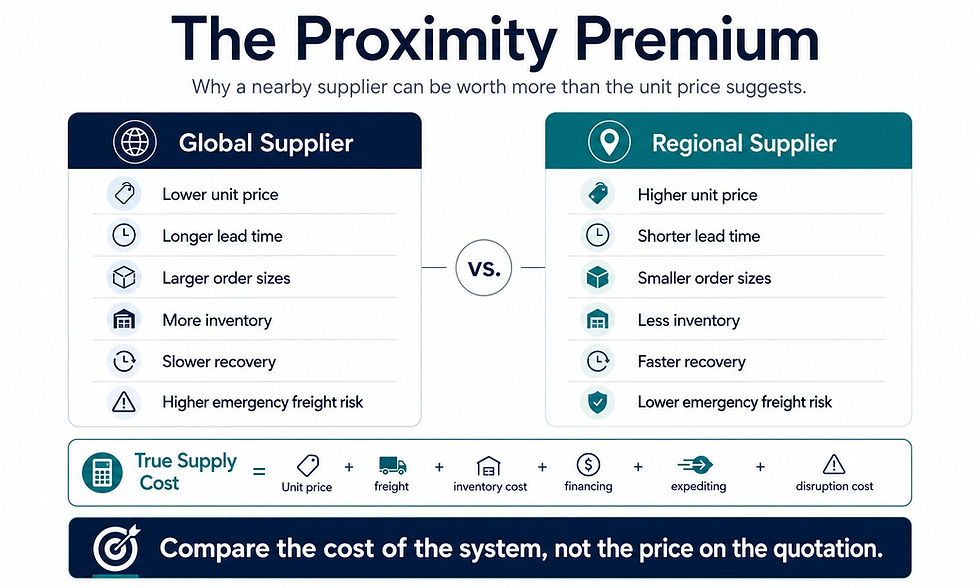
The relevant cost is the cost of the system
A more complete sourcing decision should therefore look beyond landed cost. Freight, duties and insurance matter, but so do minimum order quantities, inventory financing, quality failures, emergency shipping, obsolescence, administrative complexity and the consequences of operational interruption.
Suppose a global component costs AED 100 and a regional equivalent costs AED 106. Once freight and import handling are included, the first might effectively cost AED 103 while the second costs AED 107. On a conventional landed-cost comparison, the global source still wins.
If the regional supplier allows substantially lower average inventory, faster replacement of rejected material and far fewer emergency shipments, part or all of the AED 4 difference may disappear. If the component is operationally critical, the value of faster recovery could justify an even larger premium.
This does not mean regional suppliers are automatically cheaper once hidden costs are included. In many categories they will remain materially more expensive, and the global supplier should win.
The discipline is to calculate how much economic value proximity actually creates and refuse to pay beyond it.
Every category has a rational proximity premium
This creates a useful decision principle. Rather than asking whether a regional supplier carries a premium, management can ask how much premium this particular dependency can economically support.
For a predictable commodity available from many sources, the rational premium may be close to zero. For a product that forces the company to hold months of inventory or exposes a high-value operation to prolonged downtime, the rational premium may be considerably higher.
The calculation can incorporate reduced working capital, lower emergency logistics costs, faster problem resolution, lower expected interruption losses and the flexibility created by shorter replenishment. These benefits will never be perfectly measurable, but imperfect economic estimates are more useful than treating the purchase price as complete.
The implication is important for both buyers and suppliers. A regional producer does not need to prove that it has the lowest factory cost in the world. It needs to prove that the system operates better with it inside the network.
6. Optionality Is Valuable Even When It Is Not Being Used
A secondary source is not simply an expensive supplier
One of the most misunderstood parts of supply-chain resilience is the economics of the second supplier.
Imagine a global manufacturer supplying 80% of a critical category at excellent cost and quality. A regional manufacturer supplies the remaining 20% at a somewhat higher price. A narrow procurement analysis may conclude that consolidating everything with the global supplier would save money.
That conclusion ignores what the 20% relationship may be preserving.
The regional supplier already knows the specification, appears in the procurement system, has passed quality approval, understands expected volumes and maintains an active commercial relationship with the buyer. If the primary source becomes constrained, the company is expanding an existing relationship rather than beginning supplier discovery, testing and qualification during a crisis.
Part of the premium paid on that 20% is therefore buying the ability to change course.
Financial markets routinely recognise that an option has value even when it is never exercised. Supply chains contain similar economics. The right to move production, accelerate replenishment or call on reserved capacity can create value because management retains choices under uncertainty.
Backup capacity must be real to be valuable
This also explains why nominal second sources frequently disappoint.
A supplier receiving one trial order three years ago is not necessarily a viable backup. Its equipment may have changed, certifications may have expired, commercial terms may no longer apply and its available capacity may already be committed elsewhere.
The strongest alternative sources usually require some form of continuing economic relationship. That may involve allocating a modest share of normal volume, periodically renewing qualification, maintaining tooling, paying for reserved capacity or sharing credible demand forecasts.
These arrangements can appear inefficient during periods when the primary supplier performs perfectly. That is the nature of resilience investment.
The correct management question is not whether the backup produced a visible return this year. It is whether the cost of maintaining the option remains proportionate to the exposure it protects.
Real alternatives must fail differently
There is another condition. Two suppliers only create meaningful optionality if they are sufficiently independent.
If both depend on the same critical raw material, contract manufacturer, technology platform or transport route, the apparent redundancy may disappear under exactly the conditions for which it was created.
This suggests that sophisticated dual sourcing should deliberately consider failure correlation. The objective is not merely to have supplier A and supplier B. It is to increase the probability that when A cannot perform, B still can.
That may sometimes make a geographically closer supplier attractive. In other cases, the better second source may be in an entirely different region because independence matters more than distance.
Designed interdependence is therefore not about bringing everything closer. It is about ensuring that important alternatives are genuinely different.
7. The Most Valuable Regionalisation May Happen Below the Finished Product
Moving the final assembly is not always moving the risk
Local content can create employment, investment, industrial capability and shorter delivery times. It does not automatically remove the underlying supply dependency.
A product assembled in the Gulf may still rely on a specialised component manufactured in one overseas location. A local chemical producer may depend on imported feedstock. A regional equipment manufacturer may rely on one proprietary control system. A distributor may hold stock in Dubai while replenishment still depends entirely on one distant factory.
For buyers interested in resilience, the relevant question is therefore not simply how much of the finished product is manufactured locally. It is which difficult-to-replace bottlenecks have actually moved closer or become more recoverable.
Sometimes regionalising one small component or technical capability can create more resilience than localising the final assembly of an entire product. A locally available spare part, repair capability, tooling process or specialist service may reduce recovery time dramatically even when most of the product remains globally manufactured.
This changes how businesses should think about local supplier development. The highest-value opportunity may not be recreating an entire industry. It may be identifying the small number of bottlenecks that determine whether larger systems can continue operating.
Supplier development can create an option the market does not yet provide
A regional supplier will not always arrive fully capable of replacing an established international producer.
It may have the manufacturing knowledge but lack one certification. It may meet the technical specification but operate below the required scale. It may have capacity but lack sufficient demand visibility to justify investing in additional equipment. In other situations, poor payment terms or fragmented purchasing may prevent an otherwise capable SME from carrying the working capital required to serve a large customer.
This creates a strategic choice for the buyer. It can wait for the market to produce a perfect alternative, or determine whether closing a specific supplier capability gap creates enough value to justify involvement.
Supplier development is already familiar to major industrial organisations, but its strategic purpose deserves emphasis. The goal is not to support local businesses for its own sake. It is to improve the economics and recoverability of the buyer's own supply network.
Forward procurement visibility can be particularly powerful because investment often follows credible demand. The UAE's Product Offtake Initiative explicitly aggregates future purchasing requirements to identify opportunities for local manufacturing and industrial investment, with more than AED 180 billion of opportunities across over 5,000 products currently identified.
The same principle works at company level. When a capable supplier can see realistic future volume, it becomes easier to justify machinery, certification, inventory and technical investment.
8. Inventory Should Be Managed Against Recovery, Not Ideology
Lean and resilient are not opposites
Inventory has spent decades being treated primarily as something to minimise. In most businesses, that instinct is healthy. Excess stock consumes cash, requires storage and increases the risk of obsolescence.
The mistake is turning an efficiency principle into an absolute rule.
An additional AED 500,000 of inventory is wasteful when it protects a product that can be replenished tomorrow. The same AED 500,000 may be an excellent investment if it protects a dependency capable of stopping AED 50 million of output while an alternative supplier requires months to qualify.
The correct amount of inventory therefore depends partly on recovery capability. A business that can restore supply quickly requires less protection than one whose alternatives take months to activate.
This allows companies to become leaner and more resilient at the same time. They can reduce inventory in categories where replenishment is fast and alternatives are abundant, while deliberately increasing protection around a small number of difficult-to-recover dependencies.
Compare resilience investments against one another
Once a dependency is understood, inventory should compete with other solutions.
Suppose a business can continue operating for 30 days after a critical supplier becomes unavailable, but restoring normal supply would take approximately 80 days. The organisation effectively has a 50-day period it needs to protect.
Additional inventory may close that gap. So might a regional supplier capable of restoring supply within 20 days. Engineering may be able to approve an alternative component. A contract manufacturer may provide emergency capacity. A redesign might remove the dependency altogether.
Each option has a cost and a level of credibility.
This reframes resilience as capital allocation rather than procurement compliance. Management is no longer asking whether the company should “hold more stock” or “buy regionally”. It is deciding which intervention creates an acceptable recovery position at the lowest sensible economic cost.
That is a much more mature question, and it remains useful whether the company has twenty employees or twenty thousand.
9. Leadership Should Govern Structural Exposure, Not Individual Purchase Orders
Procurement performance and business resilience are different questions
A supplier can deliver on time for five consecutive years and still represent one of the largest structural risks in a company.
Conventional procurement metrics tell management whether suppliers are performing. They do not necessarily tell leadership how much of the business depends on capabilities that would be slow or difficult to replace.
The distinction matters when sourcing decisions affect much more value than the procurement contract itself. A company might save AED 3 million annually by consolidating a category with one supplier. If the same decision makes AED 200 million of revenue dependent on one production location with a six-month recovery period, the sourcing decision has moved beyond procurement.
Finance sees capital and margin. Operations understands downtime. Engineering understands substitutability. Procurement understands supplier economics and availability. Commercial teams understand customer commitments.
Structural supply decisions become stronger when these perspectives are brought together around the dependency rather than around the purchasing department.
Management needs a small number of decision-quality measures
Large companies already possess extensive procurement dashboards. Adding another hundred supplier-risk indicators rarely improves judgement.
For critical dependencies, a smaller set of questions is more useful. How long can the business continue without this capability? How long would credible recovery take? Are the available alternatives genuinely independent? What economic value is exposed during the gap? How much does the organisation currently spend to protect itself?
Those questions connect operations, finance and sourcing in a way that supplier scorecards alone cannot.
They also reduce the need to predict specific disruptions. Management does not need to know whether the next problem will involve geopolitics, a port, cyber risk, a factory accident or an upstream shortage. It needs to understand which important assumptions the business cannot afford to have wrong.
Events around the Strait of Hormuz in 2026 have provided another reminder of how quickly transportation and commodity shocks can spread through wider supply chains. UN Trade and Development reported significant effects on freight rates, insurance, energy costs and logistics during the disruption, while later assessments noted that adjustment effects could persist even as shipping resumed.
The leadership lesson is not to design supply chains around one particular chokepoint. It is to build the ability to absorb surprises whose exact form cannot be known in advance.
10. The Commercial Opportunity for Gulf Suppliers Is to Sell a Better Supply Architecture
“We are local” is not enough
The same changes that matter to buyers create an important opportunity for Gulf manufacturers, distributors and industrial service companies.
Many will position themselves around local content, national manufacturing or shorter distance. Those messages may help open conversations, particularly where procurement policy rewards local economic contribution, but they are rarely enough to win durable business.
A sophisticated buyer wants to know what becomes better if the supplier enters the network.
Perhaps the customer can carry 25 fewer days of inventory. Perhaps replenishment falls from ten weeks to ten days. Perhaps the supplier can provide emergency production, hold consignment stock, customise smaller runs or replace rejected goods within 48 hours. Perhaps it gives the customer an independent source for a category previously concentrated in one country.
Those are stronger propositions because they translate proximity into business economics.
Becoming the second source can be a powerful market-entry strategy
Regional suppliers also do not always need to replace established global incumbents.
A global producer may be almost impossible to beat on unit economics because it has enormous scale, mature technology and decades of operating experience. Attempting to win the entire account can therefore put a regional SME into a competition it is structurally unlikely to win.
The customer's need for optionality creates another route.
A regional company may become the qualified secondary source, the provider for urgent orders, the supplier of customised quantities or the capacity that can expand when the primary network is constrained. Over time, strong performance may earn more normal volume, but the initial value proposition is different.
This is particularly relevant in the Gulf, where new industrial capacity does not need to displace global supply to become commercially important. It can become the second layer that makes global supply safer and more responsive.
The customer gains an option. The regional supplier gains an entry point.
Industrial localisation creates markets far beyond manufacturing
There is a second commercial opportunity that is easy to underestimate.
Every new manufacturing facility creates requirements around itself. It needs logistics, equipment, maintenance, recruitment, financing, insurance, cybersecurity, software, engineering, certification, packaging, testing, training, warehousing, professional services and specialist contractors.
For many Gulf B2B businesses, the opportunity created by industrial regionalisation will therefore have little to do with manufacturing products themselves. The opportunity will come from identifying where new capacity is forming and understanding what those businesses will need as they scale.
This transforms supply-chain development into a market-intelligence question. A company following new industrial clusters, procurement commitments and manufacturing investment can often identify future B2B demand before it becomes obvious in conventional sales markets.
The firms that understand the ecosystem around industrial growth may capture as much opportunity as those operating the factories at its centre.
11. Building a Gulf Supply Chain That Is More Resilient Without Becoming Less Global
Regionalisation should strengthen global participation
The strongest Gulf supply network would not turn inward.
Global trade has been central to the region's development and will remain essential. Advanced technology, specialised equipment, intellectual property, raw materials and manufacturing capabilities will continue to move between the Gulf and the rest of the world.
The strategic opportunity is to make the region a stronger node within those networks.
Saudi Arabia's industrial strategy explicitly combines domestic resilience with becoming an integrating regional manufacturing hub, while current WTO evidence shows global value chains increasingly adapting through regionalisation rather than wholesale retreat. Those directions are compatible: greater Gulf industrial depth can strengthen the region's participation in global production rather than replace it.
A stronger regional network can serve Gulf customers while also exporting to Africa, Asia and Europe. Regional manufacturers can specialise rather than duplicate one another. Distribution and logistics capabilities can connect international suppliers with growing regional demand.
The prize is therefore larger than import substitution. It is to build enough capability within the Gulf that companies have more choices locally and regionally while Gulf suppliers themselves become increasingly competitive internationally.
Network density changes the strategic value of geography
This is why the concept of regional network density matters so much.
One additional local supplier creates one additional option. A region containing multiple manufacturers, technical service providers, logistics networks, qualified labour pools, testing facilities, distributors and financing sources creates something much more valuable: the ability to reconfigure.
When a company loses one route, another can be used. When one supplier cannot expand, another may exist nearby. When a product specification needs to change, technical capability is accessible. When demand suddenly increases, a denser network offers more places from which additional capacity can emerge.
That is how resilience becomes an economic characteristic of an ecosystem rather than merely a contingency plan inside an individual company.
For the Gulf, this may ultimately be one of the most important consequences of industrial development. The value of another factory is not limited to the output of that factory. It adds another node to a network from which other businesses can build.
12. The Supply Chain Worth Building
The most resilient company is not the one with the greatest number of suppliers, the largest inventory or the highest percentage of local purchasing. Those measures can all increase while the underlying business becomes less competitive.
A stronger company understands where dependence creates genuine advantage and where it creates unnecessary exposure. It knows which global suppliers deserve concentrated volume because their scale or technology is exceptional. It knows where a regional source is worth maintaining even at a modest premium because recovery becomes faster. It understands when strategic inventory is cheaper than supplier diversification and when redesigning a product is more rational than protecting a difficult dependency forever.
This is why supply-chain strategy increasingly resembles portfolio management. Every dependency consumes or preserves some combination of capital, efficiency, flexibility and resilience. Management's role is to decide where each of those resources creates the greatest return rather than maximising one measure across the entire network.
For Gulf businesses, the available portfolio is becoming richer. New industrial capacity in Saudi Arabia and the UAE, expanding supplier ecosystems and deeper regional connectivity are creating alternatives that did not previously exist at the same scale. Yet the correct response is not to move purchasing closer simply because it is possible. It is to use those alternatives selectively, where they improve the economics or recoverability of the business.
That also changes the meaning of resilience. Resilience is often described as the ability to withstand disruption, which encourages images of additional stock, redundant suppliers and expensive contingency plans. A better definition for business is the ability to retain economically viable choices when circumstances change.
A company with choices does not need to predict every disruption. It does not need to know which port will close, which supplier will fail or which forecast will prove wrong. It needs to know that when an important assumption stops being true, the business has another credible path forward and understands what that path will cost.
Global supply chains made distance economically manageable. The next evolution is to make dependence economically manageable as well.
The Gulf's greatest supply-chain opportunity may therefore be neither localisation nor self-sufficiency. It may be the creation of enough industrial, logistical and commercial depth that businesses can remain connected to the best capabilities in the world while becoming less captive to any single one of them.
That is the value of bringing selected suppliers closer. It does not make the business less global.
It makes the business harder to corner.


Comments